Database and Storage MCP Servers
Explore seamless integration with leading database systems and storage solutions through our Database & Storage category. From SQL to NoSQL, cloud to local storage, these integrations enable robust data management, persistence, and scalability for your AI-powered applications.
💾 Data Persistence & Storage Solutions
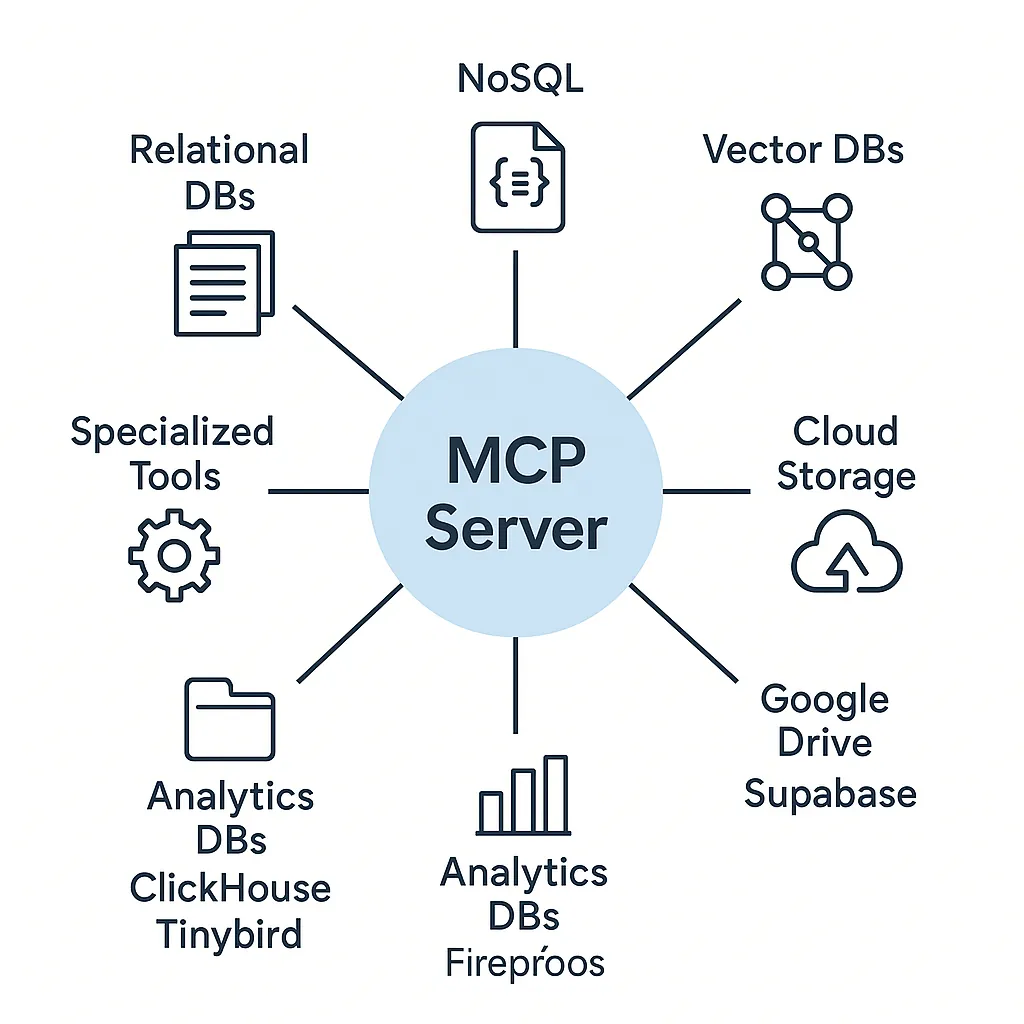 Database and Storage MCP Servers
What Are Database & Storage MCP Servers?
Database and Storage MCP servers provide AI models with the ability to interact with various data persistence systems. These servers enable models to read from, write to, and query different types of databases and storage solutions, transforming AI from stateless responders into stateful, data-aware systems.
Data Persistence
Store information that persists beyond the current conversation, enabling long-term memory and context
Structured Data Access
Work with structured data in SQL, NoSQL, and specialized formats for complex queries
Scalability
Handle millions of records efficiently with optimized queries and indexing
Integration
Connect with existing data infrastructure without migration or duplication
Security
Implement proper access controls, authentication, and encryption at rest and in transit
Advanced Queries
Leverage SQL joins, aggregations, full-text search, and vector similarity
Available Integrations by Type
PostgreSQL
Advanced open-source relational database with powerful features
MySQL
Popular open-source relational database for web applications
SQLite
Lightweight embedded database ideal for local applications
Neon
Serverless Postgres with automatic scaling and branching
Implementation Best Practices
🔒 Security First
- ✓ Implement proper authentication and authorization
- ✓ Use environment variables for credentials
- ✓ Enable encryption at rest and in transit
- ✓ Apply principle of least privilege
- ✓ Regular security audits and updates
⚡ Performance Optimization
- ✓ Index frequently queried columns
- ✓ Use connection pooling
- ✓ Implement caching strategies
- ✓ Optimize query patterns
- ✓ Monitor and analyze slow queries
🛡️ Reliability & Resilience
- ✓ Graceful error handling
- ✓ Implement retry logic with exponential backoff
- ✓ Connection health checks
- ✓ Automatic failover mechanisms
- ✓ Backup and recovery strategies
📊 Monitoring & Observability
- ✓ Track query performance metrics
- ✓ Monitor connection pool usage
- ✓ Log all database operations
- ✓ Set up alerts for anomalies
- ✓ Regular performance reviews
Available Database & Storage MCP Servers
Explore the complete collection of 20 database & storage MCP servers with configuration templates and setup guides:
| Server | Description | Setup Guide |
|---|---|---|
| Airtable | Airtable MCP servers enable AI models to interact with Airtable bases, providing capabilities for base management, record operations, field configuration, and structured data automation. | Setup Guide |
| ArangoDB | ArangoDB MCP servers enable AI models to interact with ArangoDB databases, providing capabilities for document operations, graph queries, AQL queries, and multi-model data management. | Setup Guide |
| Chroma | Chroma MCP servers enable AI models to interact with the Chroma embedding database for vector search, collection management, and document operations. | Setup Guide |
| ClickHouse | ClickHouse MCP servers enable AI models to interact with ClickHouse databases, providing capabilities for high-performance analytical queries, data warehousing, and real-time analytics. | Setup Guide |
| DataBridge | DataBridge MCP servers enable AI models to interact with local databases for contextual information, supporting persistent storage and unified access to ML services. | Setup Guide |
| Elasticsearch | Elasticsearch MCP servers enable AI models to interact with Elasticsearch, providing capabilities for searching documents, analyzing indices, and managing clusters. | Setup Guide |
| Filesystem | Filesystem MCP servers enable AI models to interact with local file systems, providing capabilities for file operations, directory management, and secure file access within specified boundaries. | Setup Guide |
| Google Drive | Google Drive MCP servers enable AI models to interact with Google Drive, providing capabilities for file search, content retrieval, and seamless integration with cloud storage. | Setup Guide |
| Milvus | Connect AI assistants to Milvus, the open-source vector database, for semantic search, vector storage, and hybrid query operations through the Model Context Protocol. | Setup Guide |
| MongoDB | MongoDB MCP servers enable AI models to interact with MongoDB databases and MongoDB Atlas, providing capabilities for document operations, aggregation pipelines, cloud database management, and natural language queries. | Setup Guide |
| MySQL | MySQL MCP servers enable AI models to interact with MySQL databases, providing capabilities for structured data operations, SQL queries, transaction management, and relational data management. | Setup Guide |
| Neon | Neon MCP servers enable AI models to interact with serverless PostgreSQL databases, providing capabilities for structured data operations, SQL queries, database branching, and automatic scaling in a fully managed environment. | Setup Guide |
| Pinecone | Integrate Pinecone with your AI assistants using the Model Context Protocol (MCP) for enhanced vector database interactions. | Setup Guide |
| PostgreSQL | PostgreSQL MCP servers enable AI models to interact with PostgreSQL databases, providing capabilities for structured data operations, SQL queries, transaction management, and advanced data indexing. | Setup Guide |
| Redis | Redis MCP servers enable AI models to interact with Redis databases, providing capabilities for key-value operations, caching, pub/sub messaging, and high-performance data structures. | Setup Guide |
| S3 | S3 MCP servers enable AI models to interact with Amazon S3 object storage, providing capabilities for file operations, metadata management, and versioning in a secure and scalable environment. | Setup Guide |
| SQLite | SQLite MCP servers enable AI models to interact with SQLite databases, providing capabilities for structured data operations, SQL queries, and local data management. | Setup Guide |
| Supabase | Supabase MCP servers enable AI models to interact with Supabase backends, providing capabilities for PostgreSQL databases, real-time subscriptions, authentication, and storage operations. | Setup Guide |
| Vectara | Vectara MCP servers enable AI models to interact with Vectara's RAG platform, providing capabilities for fast and reliable Retrieval-Augmented Generation, semantic search, and hallucination correction. | Setup Guide |
| WhoDB | Connect AI assistants to WhoDB, the all-in-one database management tool, for querying and exploring PostgreSQL, MySQL, SQLite, MongoDB, Redis, and more through MCP. | Setup Guide |
Getting Started
Choose Your Database
Select the appropriate database or storage solution based on your data structure, scale, and access patterns
Set Up Infrastructure
Deploy your chosen database locally for development or provision cloud resources for production
Configure MCP Server
Install and configure the MCP server with connection credentials and access controls
Design Schema
Define your data models, tables, indexes, and relationships based on your application needs
Implement Operations
Create the necessary CRUD operations, queries, and business logic through the MCP interface
Test & Monitor
Thoroughly test all operations and set up monitoring to track performance and reliability
Need Help Choosing?:
SQL databases (PostgreSQL, MySQL) are great for structured data with complex relationships. NoSQL databases (MongoDB, Redis) excel at flexible schemas and high-speed operations. Cloud storage (S3, Google Drive) is ideal for files and media. Specialized databases serve specific use cases like analytics or graphs.
Explore More MCP Categories
Related Articles & Guides
 #ai
#aiAI/ML Tools MCP: Seamless Integration for AI Workflows
Integrate leading AI/ML frameworks, model management, and training pipelines with AI/ML Tools MCP. Enable robust model serving, training orchestration, and MLOps workflows.
Stateless MCP 2.0: Deploying Serverless Tools on Cloudflare & Railway
Complete implementation guide to the MCP 2.0 stateless transport: deploy serverless tool endpoints on Cloudflare Workers and Railway with zero idle cost.
 #mcp
#mcpMCP Specification 1.2 — Remote Servers and Authentication
Complete reference guide to MCP Spec 1.2's remote server support with standardized OAuth 2.1 authentication. Covers the auth flow, migration path from local to remote servers, Streamable HTTP transport, and implications for agent architecture.